Kootenai River in NW Montana, near Canadian Border

Kootenai River in NW Montana, near Canadian Border
photo by Gene Tunick of Eureka, Montana
Showing posts with label Montana is Burning. Show all posts

Saturday, February 23, 2013

Tip O'Day #423 - Flashing Back

Guest blogger Ben Drake flashes back to earlier today, when he had a question about flashbacks.

Does every flashback need a catapult?

I am a lover of the flashback. I recently read a very good story with several flashbacks in it, and I just wrote a story with some attempts at flashbacks on my book site. They are not as easy as one would think. An editor I know has told me about one rule for flashbacks – there needs to be a trigger for them.

But what about when the character is insane? In my own mind I don’t need a flashback catapult when I am transported back into the actual, strong memory. Then again, it has been said that I do not have the soundest of minds.

Dixon says: Thanks, Ben. In my opinion, there’s only one rule for a flashback (or a flashforward) – you need to be absolutely clear when you’re going into and coming out of the flashback.

Flashbacks can be any length at all. They can be one phrase long – The smoke from the fire made Paul break out in a sweat, taking him back to the burning crack house in Phoenix when he accidentally shot an innocent kid. They can be a hundred pages of longer. In the novel The Godfather, there’s a huge flashback right after Sonny’s wedding, going back to Don Corleone’s youth in Sicily. I’ve seen books where the opening and closing chapters are bookends, in the present tense, and the rest of the story is a flashback. An example of that is The Man Who Shot Liberty Valance.

The Liberty Valance short story by Dorothy Johnson (as well as the movie) is also an example of a flashback within a flashback, when Sen. Stoddard (Jimmy Stewart) reveals that Tom Doniphon (John Wayne) actually shot bad guy Liberty Valance. To get even more complicated, there are cases of a flashback within a flashback within a flashback, such as Six Degrees of Separation.

It’s easy when the flashback starts and ends at chapter breaks. Thirty years earlier makes a nice transition. The same thing goes for a scene break. When the flashback occurs in the middle of a scene, the author needs to go out of her way to ensure clarity without jerkiness, both going in and coming out. My suggestion is to do your best and then show it to some critique partners (beta readers) to see if what’s in your mind works on the page.

As for Ben’s question about an unbalanced character, if that person has already been established as unreliable, there’s no reason a flashback shouldn’t work. In my WIP, a thriller tentatively titled Montana is Burning, there’s a schizophrenic character named Winnifred who holds lengthy discussions with her dead mother, her son (who may or may not have been aborted), the devil, and various imps. If Winnifred tells you today is Saturday, you’d still better check a calendar. Her flashbacks are some of the most entertaining parts of the novel, even though the reader isn’t sure whether they actually occurred.

Ben’s guest post was a fine example of brevity. Unfortunately, I rarely demonstrate that talent.

Tuesday, February 14, 2012

Tip O'Day #292 - Setting & Theme

The two previous blog posts have talked about the importance of setting, and the possibility it can actually become a character in your story - think The Perfect Storm. Another consideration is the use of setting to reinforce the mood and themes of your story. There’s a reason few noir scenes are set on sunny California beaches. The following is the third excerpt from my forthcoming thriller, Montana is Burning, which will be out in Kindle this summer.

The golden eagle sliced through the air, miles from where scattered rain drenched a small clearing and the stream that ran through it. She spiraled upward with little effort, riding a thermal current as she waited for the storm to break up.

The eagle was the perfect aerial predator, with cruel talons and a beak that could disembowel an adult sheep. She was death from the sky. Lacking an owl’s night vision, she couldn’t hunt after dark, even though high winds had kept her pinned to her aerie for more than a week and starvation threatened.

She circled and watched. In a valley far below, dry lightning struck a large snag and it burst into flames. Since no animals fled from the fire, the eagle quickly lost interest. She flew on.

The isolated storm finished venting its fury on the clearing and sped east. Dim memories drew the eagle above a stream where salmon returned each summer’s end and trout grew fat and pink on the helpless spawn – ancestral memories of hunts and feasts by eagles long dead but memories no less real. The raptor smelled blood and tasted flesh as if the kills had been her own.

The great bird spotted the glitter of whitewater skittering across rocks made smooth by eons of glacial runoff, and saw dark shapes carving their way beneath the surface.

She dipped a chocolate-brown wing and dropped below the air current. The eagle descended slowly at first, then folded her wings next to her body to plunge like lightning drawn to earth. Her freefall lasted hundreds of feet before she spread wide her wings, pulling out of the meteoric dive. With hardly an eddy on the water’s surface, she ripped a trout from the icy stream and started back to her craggy perch, blood on her talons and savagery in her cry.

As she climbed through the warm air, the golden eagle spotted the valley where lightning struck a snag earlier. Flames burned greedily and jumped to neighboring scrub pine. Only the eagle saw.

In the great bird’s wake, a wolf erupted into the opening and sprang across the stream, but the whitetail he had been stalking already bounded far down the slope, startled by the exultant screech from above. Stopping at the edge of the clearing, the wolf listened to the doe’s flight.

The wolf turned from the fading sound of escape. He jogged toward remembered cattle.

The world, after all, was full of prey.

Monday, February 13, 2012

Tip O'Day #291 - Setting as a Character

Setting can become a character in your story. In my novel Montana is Burning, a forest fire serves as not only backdrop, but also antagonist and instigator of events. In this second part of the novel excerpt, the fire faces death but survives.

The golden eagle circled high over a remote valley twenty miles west of Kintla, Montana.

A burning snag sent a faint column of smoke aloft. The eagle knew fire usually flushes small animals from their hiding places but not this time. A pine beetle infestation had devastated the valley, leaving behind mostly rotten stumps and scarcely any healthy trees. Despite a huge insect population, there were almost no green branches and so hardly any rodents, birds or small game lived there. Above the size of centipedes, practically no life survived in the valley.

The great bird found a sturdy branch high in an ancient pine. She waited.

Like waves rippling out from a pebble dropped in a fiery lake, a circle of flame spread around the snag, painting the pale underbelly of the clouds an angry red. The lower branches of several nearby spruce caught fire. The expanding pool lapped across the matted carpet of pine needles, burning into the forest floor until it ran out of air.

A dark cloud passed overhead, so heavy with water vapor that it began to condense. A shower doused the valley and the eagle sought shelter on a lower branch.

Flames hissed and wavered and then finally failed. As if to signal the fire's defeat, the blackened snag teetered and fell. A cloud of ash rose into the damp air then pelted back to earth with the rain.

The snag lay on its side like some grotesque wounded beast. Sheltered from the rain, its underside reflected a dim glow against the ruined forest floor. The fire lived.

The golden eagle took wing and continued her hunt.

This three-part novel excerpt concludes tomorrow, when wolf and eagle meet one another.

Sunday, February 12, 2012

Tip O'Day #290 - Setting is Crucial

I mostly put up guest posts from other writers because I think we can learn a lot from the success and failures of others, even the least experienced. However, my “Wolf & Eagle” excerpts from the forthcoming thriller Montana is Burning have had the most hits by far over the last few years. For the success of a novel, I believe setting can be just as important as character and story. The following is my attempt to convey a sense of the Montana wilderness.

As shadows lengthened in the forest, a wolf waited.

He awoke at daybreak far to the north with an empty belly. The last surviving member of his pack, he’d eaten nothing but a few rodents the last few days. Alone, he had little hope of killing larger prey.

The wolf turned south and loped toward memories of slow-moving cattle that grazed away from human scents. He stopped to rest when the sun shone directly overhead. A swath of land denuded of trees stretched into the distance to both left and right. He could smell and hear much further than he could see, and sensed no men nearby. He sprinted across. He rested again and then urinated to mark his mission and direction of travel before continuing the journey. The wolf trotted over the Whitefish and Salish Mountains before a familiar scent stopped him on the edge of a grassy meadow.

The cattle still lay in his path but only after many hours’ travel through rolling sand hills. His stomach ached. The wolf ignored his hunger and waited.

Shadows stretched into the clearing below him, masking a swift stream in smears of gray and black. The wolf breathed deep of the warm air and smelled deer.

A female. Closer this time. Down-slope and upwind.

The wolf tensed his haunches in readiness.

The whitetail deer edged closer through the shadows, yet not close enough.

The wolf felt the weather change. A storm front was passing by. The humidity rose as clouds rolled overhead, smothering the landscape in featureless murk. Lightning crackled in the distance.

The lone male might as well have been blind. Yet he smelled the sweet fragrance of tamarack, pine and aspen, the loamy earth, the rich droppings left by beast and bird, and the salty blood coursing through the doe. Even through the noisy turbulence of wind and nearby stream, he clearly heard the prey set one hoof on a leaf.

The wind began to swirl. A fat plop of rain struck the cracked earth between his paws. Water sprinkled across the parched clearing. He sensed dusty treetops shuddering at scattered drops. A blanket of heavy, moist air settled around the hunter and now he sensed only water.

He stretched out on his belly and waited.

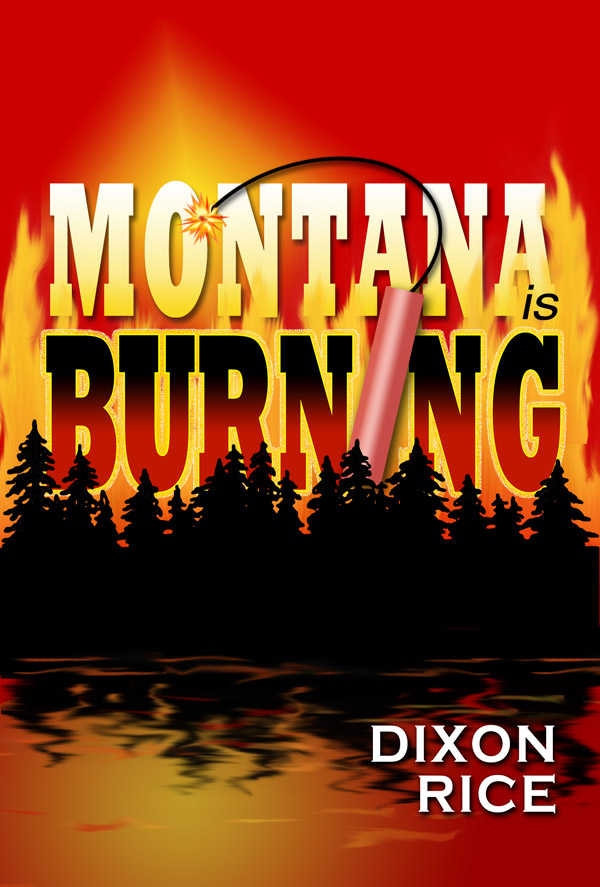
This is the first of three posts, to be continued tomorrow. Look for Montana is Burning on Kindle this summer. Suzanne Parrott of Unruly Guides designed the book cover.

Wednesday, February 2, 2011

Tip O'Day #17

Make sure your first page engages the reader.

You walk into a book store (for future readers – a retail establishment selling words printed on paper). You pick up a book and turn to page one. You might read for 30 seconds or so, maybe 15-20 lines of text, to see if the prose has any appeal. Sometimes that's all it takes - Grisham's "A Time to Kill" had me hooked from the first few lines.

So that's the test: does the prose intrigue us? Does it set up a dramatic or humorous situation, a unique character, or a fascinating locale? Does the author have a Voice that grabs us by the collar and won't let go? Is there some intangible quality to the writing style that we've admired in other books? For a real eye-opener, check out the one-page posts on WeBook website. Some are awesome but it’s amazing how other wannabe authors can fill a page with word after word and yet NOTHING HAPPENS. For some amazing examples of first paragraphs, check out Nate Bransford’s “finalists” blog post – link is to the right.

Allow me to inflict upon you an early version of the opening for my crime thriller, "Montana is Burning”. I don't have the emotional distance to tell whether this is any good, but my aim was to intrigue the reader with an interesting protagonist, locale and situation.

Paul Longo eased his lanky frame into a chair at the New Accounts desk and waited for the statuesque blonde – Elizabeth from her nametag – to get off the phone. Her shimmering emerald dress clung to all the right places. Paul didn’t mind the wait. He looked around the lobby. A small bank for a small town. Some of the windows had the bluish, dimpled look of antique glass. The pressed tin ceiling looked authentic, suggesting the building was a hundred years old or more.

The guy pushing through the copper-and-glass doors didn’t seem the slightest bit authentic. A little man, maybe five-foot-four and 130 pounds, who looked full of meth. Bulging eyes flicked nervously around the lobby, and one cheek twitched a furious beat. Still had prison pallor from his most recent stint. Both hands jammed deep in the pockets of a down vest, despite the unusual autumn heat.

Detective Paul Longo slipped the 44 caliber Super Redhawk from the shoulder holster and dangled it behind his chair. The end of its nearly ten-inch barrel touched the floor.

Saturday, January 15, 2011

Bickering Feds

Here's a scene that didn't make the final cut for my unpublished novel, MONTANA IS BURNING. I liked the characters too much to kill them off, though, so they do appear in a few later scenes. Oh, wait a minute. I just remembered - I DID kill off one of them...

Six hundred miles south of Mullen County, Montana, FBI special agent Jordan Pelzner handed an airsick bag to his traveling companion and looked past him out the window. To the east, the sun edged from behind mountains dusted with early snowfall. Pelzner looked beneath the 737’s wing at the intricate network of dikes and roadways surrounding the Great Salt Lake. Some reservoirs were full of water, others evaporated to salt beds. He wondered how many tons of salt the Mormons had extracted over the last hundred and fifty years.

The retching at his side interrupted Pelzner's wool-gathering. He handed a napkin to Fred Rugar, the senior ATF agent for the Western Region. Rugar patted the pointy chin that anchored his heavy jowls and stuffed the napkins into the airsick bag. A sour odor drifted toward the FBI man.

"You know," said Pelzner, "you have an unusual method of preparing for an investigation."

"Shut your damn face."

“Is that standard operating procedure in the Seattle ATF office -- drink yourself blind and then bust up a gay watering hole? Or is it usually the other way around?"

"For freaking missionaries, they sure got a mess of gay bars."

"Alcohol, Tobacco and Firearms..." Pelzner mused. "I suppose you can't smoke or shoot worth a damn either."

"Heaven protect us from self-righteous Fibbers. My damn head is ready to burst and here you’re thumping a bible for all you're worth. Lemme die in peace."

"That's a tempting thought, my friend, and you certainly couldn't smell much worse. Might even be an improvement for the first few days."

"I had any strength, I'd yank your tongue out."

"No, Agent Rugar, I can't let you die. Too much inter-departmental paperwork and besides, you're the big cheese on this case."

"Aw shit, don't mention cheese."

"I’m afraid explosives mean this one's an ATF case. The FBI just came along to smile at the reporters and pay the bar bill."

Rugar’s hands trembled on his lap. "Don't remind me what we're headed for. I was hoping to coast into retirement without sniffing any more crispy critters."

Pelzner watched he poor bastard’s shakes grew steadily worse. He wondered if there were any medical personnel on board. The ATF agent gripped the armrests as if the seat bucked under him. The tremors finally subsided and Rugar took a few long, slow breaths.

“Your color’s coming back, my friend," the FBI agent said. "But you’re still a bit green around the edges.”

"Takes me freaking days, sometimes weeks to get the smell of burnt flesh outta my hair and off my skin. Don't know how many suits I've gone through in the last twenty years. Stunk too much to dry clean, just threw them out."

"That's why you get the big money."

"Hah!" The ATF agent’s bitter laugh turned into a wheezing attack. Beet-red jowls quivered as he pounded his barrel chest with one hand, tightly holding the armrest with the other.

"Great impression. That's from The Exorcist, right?"

"Lord," said Rugar, raising his eyes in mock prayer, "help me live through this flight and I'll do any penance you name. Go to church. Shoot a Fibber. Any-damn-thing."

"I notice you failed to mention celibacy."

"Leave your mother and me outta this, Pelzner."

"So the subtle Fred Rugar wit lives on, despite the anticipated demise of the body. I'm sure the locals will be suitably entertained."

"Yeah, I’m really looking forward to meeting Barney Fife and the rest of the Mayberry gang. I swear, if I find one piece of evidence mishandled, I'll rip each freaking bugger a new anus."

"My friend, your attitude bodes poorly for cooperation with the Mullen County Sheriff."

"Those hicks probably don’t handle twenty felonies a year. Best for them to stand back and let the pros take over."

"You take over, Agent Rugar. I'll hold your jacket and lead the applause."

"Just make sure there's a freaking rental car waiting in East Cupcake."

"That's Edgerton."

The ATF agent turned away from Jordan Pelzner and looked at the morning sun rising past the Wasatch Mountains. "Whatever."

Thursday, November 4, 2010

Showing "A Typical Day"

At the first writers conference I ever attended, I had the opportunity to have a literary agent critique the first 50 pages of my premier novel. It started with action, just as a hundred other writers had suggested, but the agent didn't like that. I needed to show what a typical day was for the protagonist, she said, and do a better job establishing the setting. So I went back to the computer and did exactly that.

Ever since, everybody who's looked at my story says the same thing: start with action and knock off all the description.

Okay, okay, back to the opening scene where the flawed detective is sitting in the bank lobby when a meth-fueled robber walks in. But when you buy Montana is Burning, this is the descriptive, textured opening you will miss:


An Indian kid was dead, and nobody seemed to care except a lawyer barely old enough to shave.

Detective Paul Longo looked across the street at a storefront law office. Main Street in Kintla stretched all of ten blocks, and nothing much moved in either direction this autumn afternoon. Just dust and a dry wind. Paint blisters pockmarked the brooding gray edifice opposite Paul, revealing previous incarnations of chocolate brown and light blue.

The town straddled both banks of a river on the floor of a narrow valley, so the cigar box building stood stark against lodge pole pine and western larch that swept up the foothills from a mere three blocks away. Years ago, somebody had removed the large letters that ran across the second story of the stucco facade but hadn’t bothered to repaint, so the outline was still clear: Woolworth’s. On the right side of the building, a sign said Kowboy Kafe, but that door had been boarded up for years. On the left, amateurish gold lettering on the plate-glass frontage proclaimed the law office of Kevin Waagel, Esquire, the attorney retained by the tribe to look into violent or suspicious deaths, on or off the nearby reservation.

Paul pushed back the new Stetson and wiped his forehead dry. He liked the hat, a present his first day on the job from Sheriff Clyde Frye. The only nice thing anyone in Mullen County had done for him so far.

He sighed, wondering again at the wisdom of his move to Montana. A glance at his watch -- twenty minutes early for his deposition. He decided to take care of some business he’d been putting off for a month. The office of Kevin Waagel, Esquire, would still be there when he finished.

A Mullen County patrol car pulled up to the curb across the street. A deputy sheriff climbed out and nailed a sign to a telephone pole reading Re-elect Sheriff Frye. One block north, another deputy rounded the corner and stopped to pound a Holland for Sheriff sign into the library’s front lawn.

Paul shook his head and started toward Kintla State Bank.

Five minutes later, he eased into a chair at the New Accounts desk and waited for the statuesque blonde to notice him. It took awhile, what with her chatting on the phone while she rasped an emery board across a fingernail. Her shimmering emerald dress clung to all the right places. Paul didn’t mind the wait.

The tempo in these small towns, he mused, took some getting used to. Back in Phoenix, a bank would pink-slip any employee that didn’t handle the required number of transactions in the requisite time with fewer than the allowable amount of errors. This quiet valley in northwest Montana ran at a different pace than Paul had grown up with. The important things got done but with fewer ulcers in the process.

The blonde ended her conversation. Blue eyes sparkled as she pasted on her best customer service smile, but it seemed a shade brittle. I save my warmth for people who don’t sit down uninvited, the smile said.

“Elizabeth, I’d like to open a checking account.”

“Do I know you?” She wrinkled her nose. “I think I’d remember someone as tall as you and--”

“And with a nose like a hatchet, I’m not so easy to forget.” He pointed at the nameplate on her desk.

“Oh.”

“Anyway, I’m getting paid next week and figured I should put my check someplace safe. A bank came to mind.” He reached past the shoulder holster into his blazer’s inside breast pocket and pulled out a fifty. “This can start things off, until I get my first paycheck.”

Elizabeth tried her smile again. “New to the valley?”

“Been here long enough to get all my clothes out of cardboard boxes. About four weeks.”

“Goodness, how ever did you last that long without a checking account?”

Paul shrugged. “Mostly use cash.”

Her brows bunched together.

"I work for the Sheriff, Elizabeth. Believe me, cash is perfectly legal.”

“You’re that new detective, aren’t you?” The pleasure of discovery lit her face yet a shadow lurked in her eyes. Paul wondered what she’d heard. The new detective with all the big-city ideas? The one who acted too good for the local cops? The square peg?

She tapped a couple times on her computer keyboard and began taking Paul’s vital statistics, seemingly glad to be in safe territory. He answered automatically as he glanced around the historic building. With a pressed-tin ceiling, the bank must have been at least seventy-five years old, maybe a hundred. Some of the windows had the bluish, dimpled look of antique glass. The main doors were sheathed in copper both inside and out, maybe from the mines in Butte, and Paul guessed the appearance of Old-World craftsmanship was authentic.

Then a man walked through those same doors. He didn’t look one bit authentic.

Saturday, October 9, 2010

Old Farts Club excerpt from "Montana is Burning"

At the 2010 Flathead River Writers Conference, I had a very encouraging talk with Gordon Warnock from Andrea Hurst Literary Management. However, he informed me that my (supposedly) completed novel is about 30,000 words too long for a first-time author. Ouch. So I must say goodbye to some (in my opinion) wonderful chunks of verbiage that develop characterization, establish mood, and plant clues. I need to do those things with greater brevity, it appears. So here's a chapter that's being lopped out:

Ole’s CafĂ©, Kintla, Montana

Saturday – 10:00 a.m. (The morning after a nearby abortion clinic was firebombed)

Surely every coffee shop on the planet has one, a large table where the Old Farts Club gathers each morning to complain about the world going to hell in a hand basket. The round table in Ole's Cafe in Kintla had eight oak chairs.

Ralph Morrissey, the town's funeral director, walked into Ole's and saw several reporters forced to stand at the counter, even though there was still an empty chair at the big table. It was gratifying, he thought, to see that some things in this world could still be depended upon.

He took the vacant seat between banker James Otto and rancher Duke Overbeek. Everybody nodded at the mortician and Otto flipped over a clean cup for him. As usual, at least three different conversations were going on, with some fellows jumping from one to another depending on which topic caught their interest. Morrissey jumped in with the group discussing last night’s firebombing and was immediately interrupted by Huz Brandt, the local accountant.

“You missed a couple great jokes, Digger," Brandt said. "You know what you get when you cross a Mormon with an Indian?"

“A basement full of stolen canned goods," blurted insurance agent Jay Aster.

Despite having heard the joke minutes earlier, the table erupted in laughter. Morrissey, who had both LDS and Native American friends, sat stony-faced. He noticed Bobby Jones looked like he'd gotten a whiff of something rancid.

Jones spoke before Morrissey could think of a comeback. "I heard there's no humor without an element of truth. Maybe we oughta change that to humiliation."

"Lighten up, Bobby," Brandt said. "Don't tell me you didn't bust up some prairie niggers off the Rez when you were carrying a badge down in Missoula."

A muscle twitched on the retired deputy's square jaw. "Naw, I was too busy writing DUI's for members of the Chamber of Commerce."

Brandt's cheeks turned crimson. Everybody at the table knew the CPA had recently picked up his third drunk-driving ticket. They all looked around at nothing in particular, hoping somebody would change the subject before things got even more unpleasant.

Bobby Jones jumped in again to change the subject. "I almost made my first taxi trip yesterday. This college kid got busted at St. Joseph and the Border Patrol confiscated his daddy's Mercedes. He hitched a ride into town, then showed up on my porch with his sad story. 'Just some seeds, Man. Just some seeds,' he says."

"What happened?" Brandt asked. "No money?"

"Naw, he showed me more'n enough for the trip. I told him to come back at six and we'd go to Edgerton after supper. Musta got another ride, because he never showed."

Overbeek leaned forward. "Speaking of no-shows, did you hear Chief Holland ducked out of the limelight and put that new detective in charge of the arson investigation? You know, the religious nut.”

"Paul Longo is his name," Jones said. "I bumped into him at the courthouse last week. Didn't seem like a nut to me."

Huz Brandt sneered. "There's a lot of local boys coulda done the job just as well. They know the valley better than some kid just rolled into town."

"He’s no kid, Huz," Jones laughed. "Trouble is, you think anyone not drawing Social Security is still in diapers. And just because he doesn't swear every fifth word, that doesn't make him a Jesus freak."

"It's all just politics," Overbeek said. "Frye probably hoped Holland would stub his toe on this abortion clinic thing, so Holland put one of the Sheriff’s boys in charge of solving it.”

"Then the Chief’s got the wrong guy," Jones said. "Longo's no politician. Hell, he’s the only one on the force who’s not up to his butt in the election.”

Meanwhile, a discussion across the table about forest fires had evolved into a diatribe against government is general and Congress in particular. Jay Aster, the coffee klatch’s token Democrat, was taking a merciless ribbing from the other men. He turned to Morrissey after a few minutes of this abuse.

"Hey, Digger, I've never seen you this quiet before. Business can't be all that bad, I hear people are just dying to get into your place."

"Oh, I'm busy enough but the cremations are killing my bottom line. The only bright spot is the folks who choose a box-and-burn job are usually cheapskates like you who’d stiff me on the bill anyway."

James Otto, the banker sitting next to him, cleared his throat. “Wake up on the wrong side of the embalming table?”

"I’m fried over those nuts that bombed the clinic," Morrissey said. "What with them and this new militia group people are whispering about, plus the morons we send to the legislature, I'm ashamed to call myself a Montanan."

"Didn't you move here from Oregon?" Brandt needled.

"I'm serious here," Morrissey said. "The more I think about it, the more steamed I get. There's not one Montanan in a thousand who thinks murder is the way to win a political argument."

"Damn right," Overbeek said.

The funeral director brought his fist down on the table, rattling coffee cups and saucers. “The rest of us have to stand up to the pinheads responsible for this terrorist act and let them know we won't tolerate such an outrage.”

“I'm with you a hundred percent so far,” Jones said. "You got something in mind?"

Morrissey stood up. “You bet I do. Come over to the mortuary chapel at one o'clock and bring a couple friends.”